"The North Bethesda Metro station will become the epicenter of the region's life science community." — Montgomery County Executive Marc Elrich, on the county and Metro's search for a developer to build out the North Bethesda Metro site
That line was written for a press release about a request for development proposals. It reads like municipal boilerplate until you notice what it actually says: North Bethesda is getting its own jobs engine, separate from whatever is happening at Bethesda Row or in the estate streets off Wisconsin Avenue. If you have been comparing "Bethesda" home prices on a search site this fall, that distinction is the part the median doesn't tell you.
The number your search bar hands you is an average of two different bets
Pull up Bethesda's housing numbers on any given week and you will get a different figure depending on where you look, and the spread itself is informative. Redfin's tracking of Bethesda sales put the citywide median sale price at $1,349,266 in June 2026, down slightly year over year, with homes averaging 22 days on market and two offers. Movoto recorded a median sold price of $1,295,000 in August 2026 across 356 sales. Zillow's typical home value estimate as of July 2026 sat closer to $1,120,054, down 0.8% over the year. Houzeo's March 2026 breakdown split the difference between property types entirely: condos averaging around $372,500, single-family homes averaging $1,400,000, and a blended median of $1,222,500.
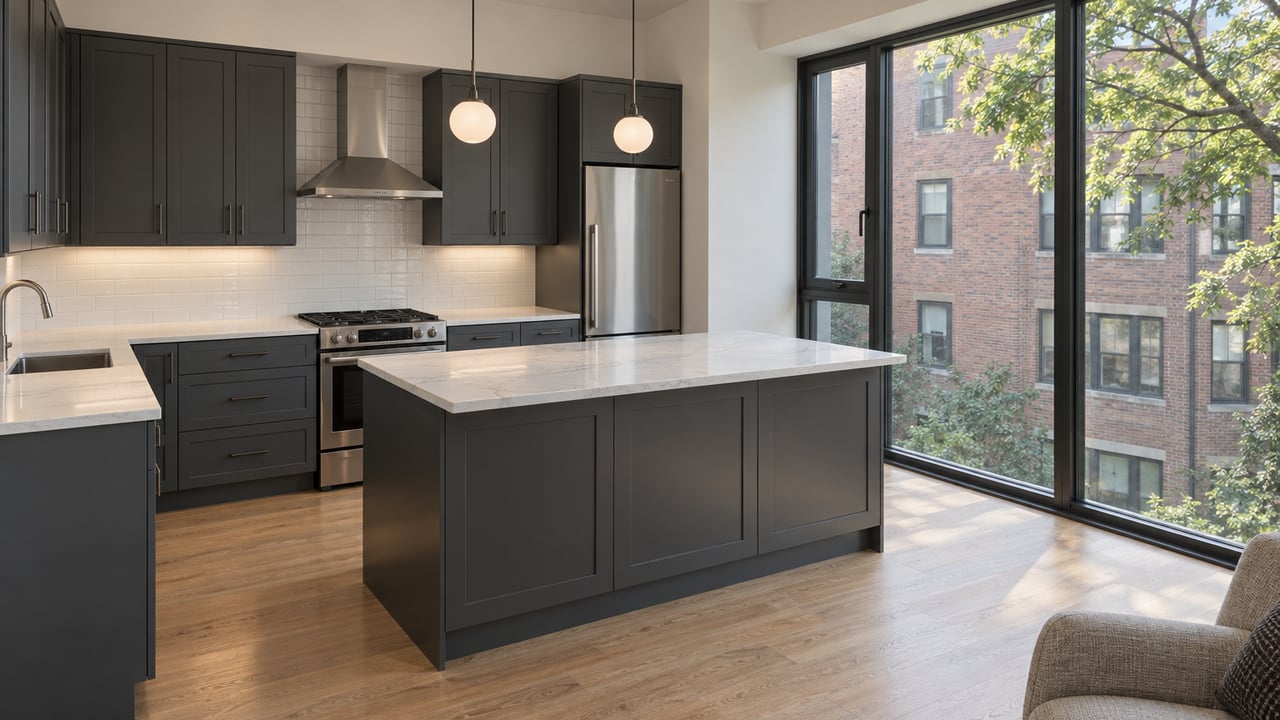
None of those sources disagree because one is wrong. They disagree because "Bethesda" is being asked to describe a shaker-style kitchen renovation in Edgemoor and a one-bedroom condo above a Rockville Pike parking garage using the same word. Zoom into the Pike District specifically, the corridor around the North Bethesda Metro station and the Pike & Rose development, and the median as of May 2026 was $514,999, with condos ranging from $244,440 to $1,590,000. That is not a rounding difference from the citywide figure. It is a different market wearing the same zip code.
Three Bethesdas share one map
The gap makes more sense once you separate what is actually being sold under each version of the name.
| Submarket | Where it is | Typical price band | What's driving it |
|---|---|---|---|
| Estate neighborhoods | Edgemoor, Kenwood, Bradley Hills | Routinely above $1.4 million, with Edgemoor listings near the Chevy Chase Club frequently pricing above $3 million | Fixed lot supply, mature landscaping, school boundaries, almost no new construction |
| Downtown condo stock | Bethesda Row, Woodmont Triangle | Roughly $400,000 for entry-level units to over $2 million for penthouses | Established walkable retail corridor, older buildings, limited new supply pipeline |
| Pike District / North Bethesda | Pike & Rose, White Flint Station, The Gallery | Median near $515,000 as of May 2026 | New construction tied directly to a Metro-anchored jobs project whose anchor building is scheduled to start construction in fiscal 2029 |
The first two categories are essentially built out. Edgemoor is not adding lots, and Bethesda Row's condo buildings are not getting younger. Whatever appreciation happens there will come from scarcity and renovation, the same forces that have always driven those markets. The third category is different, because it is the only one of the three sitting next to a jobs project that hasn't finished being built yet.
The jobs engine that's actually new here
Metro and Montgomery County selected Hines as master developer for the 13.9-acre WMATA-owned parcel at the North Bethesda Metro station, with plans for a mix of housing, office, retail, and public space anchored by the University of Maryland's Institute for Health Computing. Maryland has committed $32.6 million in state funding toward the project, including $24 million specifically for the Institute's building, $3 million for its fiscal year 2026 operating budget, and $5.6 million toward a new north entrance for the Metro station. The county has separately secured $36.6 million in infrastructure funding for streets, utilities, and public open space around the site.
The Institute's permanent building is expected to run 200,000 to 250,000 square feet, with construction scheduled for fiscal years 2029 through 2031 according to Montgomery County's own capital budget documents, timed to coincide with the new Metro entrance. This is not a rezoning proposal or a developer's rendering that may never get financing. It has a selected master developer, a named anchor tenant, committed state and county dollars, and a construction window on the county's books. That combination doesn't exist for downtown Bethesda's retail corridor or for the estate streets in Kenwood.
Supply is already moving while the anchor building is still years out
The life sciences building itself won't open until the end of the decade, but the submarket around it isn't waiting. Federal Realty's Pike & Rose, the 28-acre mixed-use development a block from the Metro station, opened its first phase in 2014 and now includes 379,000 square feet of retail, 864 residential units, a 177-room hotel, and roughly 300,000 square feet of office space, according to public records of the project. Renovated units at Bell at the Pike, one of the residential buildings inside Pike & Rose, had been scheduled to deliver new amenity spaces in September 2026.
A half mile away, construction began in March 2026 on NoBE II, a 268-unit affordable rental building at the intersection of Rockville Pike and Nicholson Lane. The project carries a total development cost of $130 million, and the county's $38 million loan toward it is the largest single permanent financing agreement Montgomery County has made for an affordable housing project to date. That is new supply landing in North Bethesda specifically, not in the estate neighborhoods and not on the Bethesda Row corridor.
What this means if you're comparing "Bethesda" prices this fall
If you are shopping with a single "Bethesda" search radius and treating every result as one market, you are comparing a fixed-supply neighborhood to a growth-stage one without realizing it. A buyer weighing an Edgemoor colonial against a Pike District condo isn't choosing between two price points in the same market. They're choosing between a neighborhood where appreciation depends on scarcity and a neighborhood where appreciation depends on whether a multi-year, publicly financed jobs project delivers on schedule.
That's not a reason to avoid North Bethesda. It's a reason to price the timeline correctly. The Institute for Health Computing's anchor building isn't scheduled to break ground until fiscal 2029 at the earliest, which means the jobs and demand it's expected to generate are a multi-year story, not something that shows up in next spring's comparable sales. Buyers looking for near-term price movement tied to that project are early. Buyers comparing today's Pike District pricing against downtown Bethesda's established condo stock, on the other hand, are comparing two markets that already behave differently and will likely keep doing so.
Frequently asked questions
Does the Pike District's lower median mean it's undervalued compared to the rest of Bethesda? Not necessarily. The lower number largely reflects newer, smaller-footprint construction and an active new-supply pipeline, both of which keep prices lower than an established, land-constrained neighborhood like Edgemoor. A lower median here is a description of what's being built, not a discount waiting to close.
When will the life sciences project actually start affecting home values? The anchor building for the University of Maryland's Institute for Health Computing is scheduled for construction between fiscal years 2029 and 2031, based on Montgomery County's capital budget. Any employment or demand effect tied to that building is realistically a multi-year horizon, not a near-term catalyst.
Comparing "Bethesda" listings without knowing which Bethesda you're actually looking at is how buyers end up either overpaying for scarcity or underestimating how long a growth story takes to pay off. If you want a clearer read on which submarket fits what you're trying to do, whether that's buying into fixed supply now or positioning ahead of a jobs project still years from completion, Team Koki can walk through the comparable sales in each of these pockets and help you figure out which one you're actually shopping.